1
Tell us what you want
A short conversation. No judgment, no jargon.
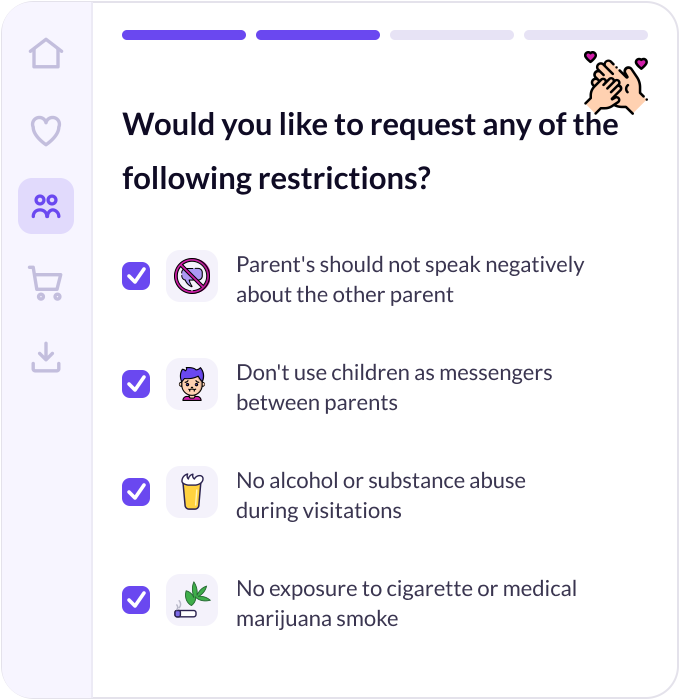

It's an Order You Can Ask For.

Spousal Support Orders
At any point during a divorce or separation, you can ask the court to set, change, or end spousal support. Here's what's most often requested:
Support while your case is pending, so the bills don't win the race to the finish line. Courts often use a formula-based guideline at this stage.
Support as part of the final judgment, weighed on factors like the length of the marriage, each spouse's earning ability, and the standard of living you shared.
When incomes or circumstances genuinely change, ask the court to bring the number back in line with reality — in either direction.
Remarriage, retirement, self-sufficiency — ask the court to reduce or terminate support when the reasons behind it have changed.
If ordered support isn't being paid, ask the court to determine what's owed and set how it will be collected.
Ask that support come straight out of the paying spouse's paycheck through an earnings assignment, instead of depending on monthly goodwill.
Spousal support requests live or die on the financial picture. Our wizard builds it from your answers, keeps every number consistent, and flags what you'll want documentation for.
We meet you where you are
Money after a separation is the conversation nobody wants and everybody has. Whether you need support to land on your feet or the amount you're paying no longer matches your life — start with the sentence that sounds like you.
 Years spent raising kids and running a household are exactly what spousal support law takes into account. You can ask the court for support while you retrain, rebuild, and get back to earning — that's not charity, it's how spousal support law is designed to work.
 Temporary spousal support exists exactly for this gap — the months between separation and a final judgment. It's requested along with your financial picture, and it can steady things while the bigger questions get resolved.
 Here's the part people learn too late: support that has already come due generally can't be undone, even when the judge agrees your situation changed. Falling behind quietly builds debt — filing a modification request puts a realistic number in front of the court.
 Spousal support generally ends when the supported spouse remarries — and a new live-in partner can also matter. But related questions usually still need to go before the judge. We prepare the request that asks the court to reduce or end support.
 The income gap between spouses is central to how support gets decided. What the court needs is the honest math, laid out completely and consistently. Our wizard builds that financial picture for you, number by number, in the format judges expect.
Answer plain questions about your marriage, work, and finances — we turn them into a court-ready Request for Order and financial disclosure. Nothing is filed until you say so, it's free to start, and every form carries our 100% court-acceptance guarantee.
Before you go it alone
Spousal support turns on numbers more than speeches: an incomplete FL-150 or one inconsistent expense line is exactly the kind of thing that stalls a request or undercuts your credibility.

An FL-300 rarely files alone — one missing companion form and the clerk can bounce the whole packet.

Those boxes decide what the judge is asked to order. The wrong one gets your request misread — or denied.

Judges read hundreds of pages a day. A declaration that vents instead of explains buries your ask.

Served the wrong way, or a day late, and your hearing slips while the problem keeps going.
This is exactly why people hand us the paperwork: every form picked, filled, and consistent — for one flat price, with our 100% court-acceptance guarantee.

Why we exist
We built Legalfina because you shouldn't have to spend $4,000 on a lawyer to fill out a form. Attorneys are worth every dollar for the hard stuff — standing up for you in court, fighting a truly contested case. But filing your initial divorce, custody, or restraining-order paperwork isn't that. It's the same court-accepted result, without the bill.
The process
A short conversation. No judgment, no jargon.
Every form and every question, answered in plain English you actually understand.
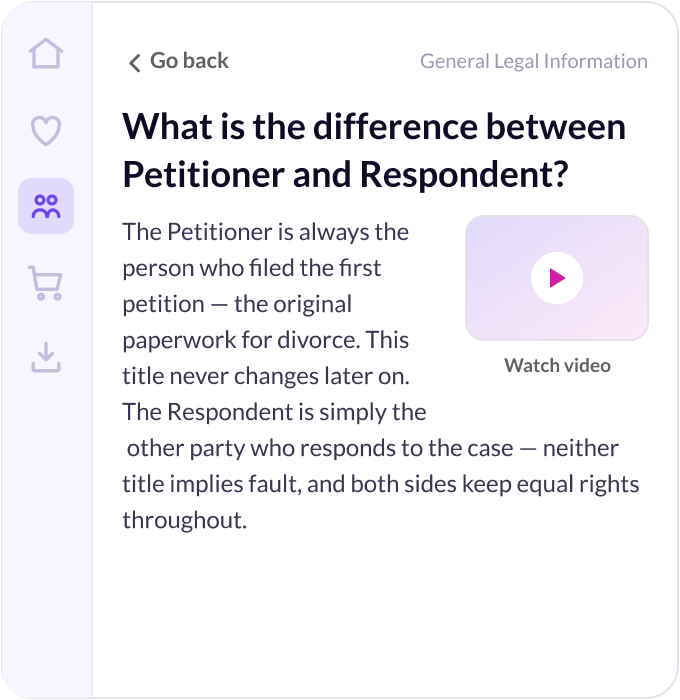
Plain English. Change anything. Ask us anything.
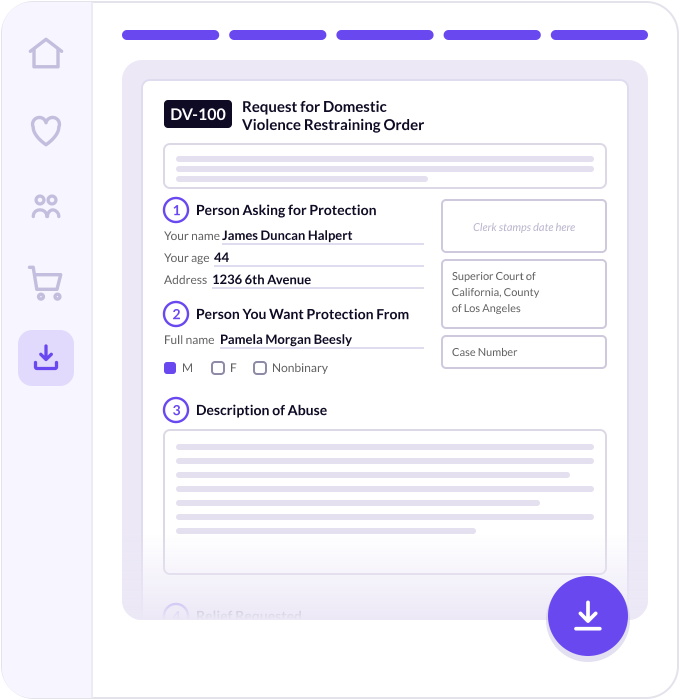
A few plain questions to get started.
Built for California
Family law is local. A filing that flies in San Francisco gets kicked back in San Bernardino. We know the quirks of all 58 California counties — because we've walked into all of them.

One flat price
One honest number for the whole case. Tell us what you're doing — we'll show you exactly what it costs, whether you're filing first or answering your ex's paperwork.
Questions, honestly answered
If yours isn't here, write us. A human will answer, usually the same day.
It depends on the stage. Temporary support (while the case is pending) is usually calculated with a formula-based guideline. Long-term support at judgment is weighed on a list of statutory factors — the length of the marriage, each spouse's earning capacity, age and health, the marital standard of living, and more. Either way, the court works from the financial paperwork in front of it — which is why yours needs to be complete and consistent.
There's no automatic answer, but a commonly used reference point: for marriages under ten years, support often runs around half the length of the marriage, while longer marriages give courts more open-ended discretion. The judge decides based on the specific circumstances — your paperwork is where those circumstances get told.
Absolutely. Spousal support in California is gender-neutral — it's about the financial reality between two spouses, not who's asking. If your spouse out-earns you significantly, the request works exactly the same way.
Generally no — California is a no-fault state, so support is decided on financial factors, not on who wronged whom. There are narrow exceptions (for example, certain domestic violence convictions can matter). The productive path is almost always the financial case, told clearly.
The FL-300 (Request for Order) plus a current FL-150 (Income & Expense Declaration) form the heart of it, along with the forms for filing and serving your ex. Our wizard prepares the full set and keeps every figure consistent across them.
Usually yes, unless your judgment says otherwise. Either ex-spouse can ask the court to modify or terminate support when circumstances genuinely change — job loss, retirement, remarriage, a new household. Until a judge signs a new order, though, the existing one keeps accruing — file first, don't just stop paying.
For orders made after 2018, federal law generally makes spousal support neither deductible for the payer nor taxable income for the recipient — but state treatment differs and older orders follow older rules. For your specific situation, that's a question for a tax professional; we'll get the order itself right.
Child support is for the children's needs and follows a mandatory statewide formula. Spousal support is between the adults and gives judges more discretion. They're calculated separately, can both be requested — even on the same FL-300 — and our wizard handles each correctly.
No — we're a licensed and bonded Legal Document Assistant service. We prepare your paperwork, and every step of our wizard is reviewed and approved by attorneys licensed in your state. If you'd like one-on-one legal advice, you can add an attorney consultation anytime.
Filling out your forms is free — you pay one flat price only when you're ready to download or file, with payment plans available. Compare that with the retainer an attorney would ask just to prepare the same request, and you'll see why we exist.
Your footing back
Whether you're asking for support or asking to adjust it, living in financial limbo wears you down a little more every month.
Let Legalfina prepare your spousal support paperwork quickly, affordably, and on your terms.
 Refer your friends
© 2021 - 2026 Legalfina Inc. All rights reserved.
LDA License #172 (Alameda County)
35111F Newark Blvd #314, Newark, CA
408-673-0810
