1
Tell us what you want
A short conversation. No judgment, no jargon.

Ask the Court to Level the Field.

Attorney's Fee Orders
If the other side can afford a lawyer and you can't, you can ask the court to even the field. Here's what's most often requested:
When one side out-earns the other, ask the court to order a contribution toward your attorney's fees so both sides can afford to be heard.
Ask for fees connected to a particular motion or issue — like having to respond to requests your ex keeps filing.
When the other side's behavior needlessly drives up the cost of the case, ask the court to make them bear that cost.
Filing fees, expert costs, other litigation expenses — these can be part of what you ask the court to allocate.
Separate from attorney's fees: if you can't afford the court's own filing fees, we prepare the fee waiver request too.
Fee requests involve more moving pieces than most — our wizard keeps every form and every number consistent, so they tell one story.
We meet you where you are
Family court is supposed to be a level field, and the law says access to a lawyer shouldn't depend on which spouse controls the money. If the other side has counsel and you have a calculator, start with the sentence that sounds like yours.
 The law addresses this head-on: when there's a real gap between what each side can afford, you can ask the court to order the other side to contribute to your attorney's fees — so both of you can actually be heard. It's called a need-based fee request.
 Fee requests aren't a one-time, start-of-case thing — they can be made at any point, for the road ahead as well as the road behind. If the imbalance is grinding you down mid-case, that's precisely when the request belongs in front of the judge.
 Courts can order one side to pay the other's fees as a consequence for conduct that needlessly drives up the cost of the case — endless motions, stonewalling, refusal to cooperate. The behavior you're describing has a paperwork answer, and it isn't suffering quietly.
 A need-based award can fund representation going forward — money toward a retainer, not just reimbursement after the fact. The request stands on the financial picture: their ability, your need, laid out completely and consistently.
Answer plain questions about the case and both sides' finances — we turn them into a court-ready Request for Order with the fee-request attachments filled in and consistent. Nothing is filed until you say so, and every form carries our 100% court-acceptance guarantee.
Before you go it alone
Fee requests get denied on paperwork more often than on merits: a stale FL-150, a missing FL-319, or numbers that don't match across forms is often all it takes.

An FL-300 rarely files alone — one missing companion form and the clerk can bounce the whole packet.

Those boxes decide what the judge is asked to order. The wrong one gets your request misread — or denied.

Judges read hundreds of pages a day. A declaration that vents instead of explains buries your ask.

Served the wrong way, or a day late, and your hearing slips while the problem keeps going.
This is exactly why people hand us the paperwork: every form picked, filled, and consistent — for one flat price, with our 100% court-acceptance guarantee.

Why we exist
We built Legalfina because you shouldn't have to spend $4,000 on a lawyer to fill out a form. Attorneys are worth every dollar for the hard stuff — standing up for you in court, fighting a truly contested case. But filing your initial divorce, custody, or restraining-order paperwork isn't that. It's the same court-accepted result, without the bill.
The process
A short conversation. No judgment, no jargon.
Every form and every question, answered in plain English you actually understand.
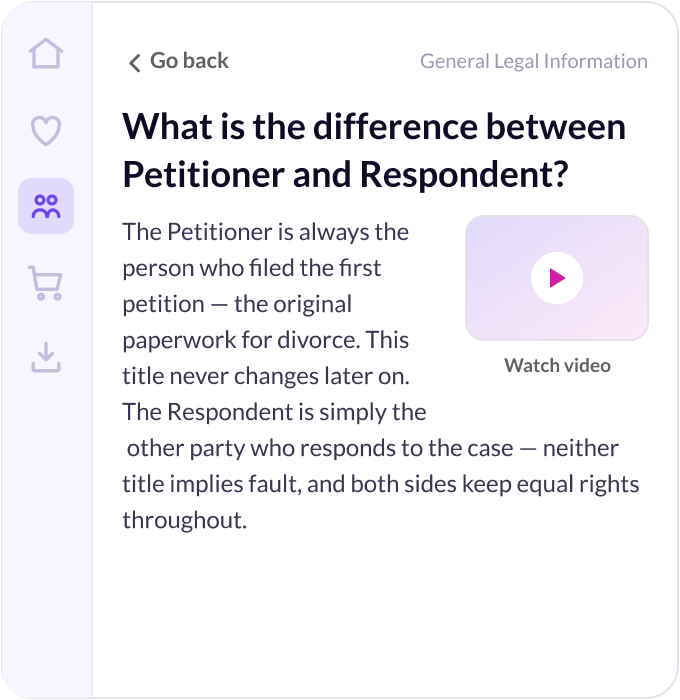
Plain English. Change anything. Ask us anything.
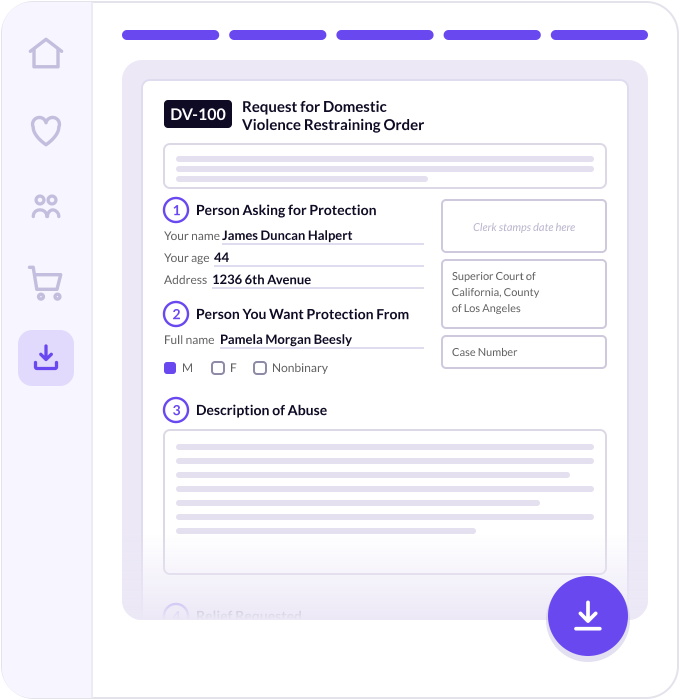
A few plain questions to get started.
Built for California
Family law is local. A filing that flies in San Francisco gets kicked back in San Bernardino. We know the quirks of all 58 California counties — because we've walked into all of them.

One flat price
One honest number for the whole case. Tell us what you're doing — we'll show you exactly what it costs, whether you're filing first or answering your ex's paperwork.
Questions, honestly answered
If yours isn't here, write us. A human will answer, usually the same day.
For need-based requests, the court looks at two things: whether there's a real disparity in access to funds, and whether the other side has the ability to pay. If both are there, California law (Family Code section 2030) directs the court to order a contribution so each side can afford representation. The whole request turns on the financial picture — which is why the paperwork has to be complete and consistent.
No. Need-based fee awards aren't a prize for winning — they exist so both sides can afford to be heard while the case is happening. Sanctions-based fees are different: those are tied to the other side's conduct, not to the outcome of the underlying dispute.
California law (Family Code section 271) lets courts order one side to pay fees as a consequence for conduct that frustrates settlement and drives up costs — endless motions, hiding the ball, refusing to cooperate. It's the court's tool for making obstruction expensive for the person doing the obstructing.
Fee awards can fund representation going forward — including retainer money — not just reimburse what you've already spent. How to sequence hiring counsel and requesting fees in your specific case is a genuinely good question for an attorney consultation, which you can add anytime.
The FL-300 Request for Order carries the request, with the FL-319 (Request for Attorney's Fees and Costs Attachment), the FL-158 supporting declaration, and a current FL-150 Income & Expense Declaration. Four forms that all have to tell the same financial story — our wizard fills them from one set of answers so they can't drift apart.
They solve different problems. An attorney's fee order makes the other side contribute to your lawyer's bill. A fee waiver (form FW-001) excuses you from the court's own filing fees when you can't afford them. Many people qualify for the waiver while also requesting fees — we prepare both.
You state what you know — income, lifestyle, accounts you're aware of — and the process requires both sides to exchange financial declarations, so your ex must file their own FL-150 under penalty of perjury. Gaps and inconsistencies in their disclosure are themselves something the court can weigh.
That's a judgment call about your specific numbers — but remember the request itself doesn't require hiring a lawyer first, and preparing it with Legalfina costs one flat price, not a retainer. For many people the math is straightforward.
No — we're a licensed and bonded Legal Document Assistant service. We prepare your paperwork, and every step of our wizard is reviewed and approved by attorneys licensed in your state. If you'd like one-on-one legal advice, you can add an attorney consultation anytime.
Filling out your forms is free — you pay one flat price when you're ready to download or file, with payment plans available. And if the court's own filing fee is a hardship, the fee waiver paperwork is part of what we prepare.
A fair fight
Facing a lawyer across the table with nothing but your own nerve is a kind of stress no one should carry through a family case.
Let Legalfina prepare your attorney's fees request quickly, affordably, and on your terms.
 Refer your friends
© 2021 - 2026 Legalfina Inc. All rights reserved.
LDA License #172 (Alameda County)
35111F Newark Blvd #314, Newark, CA
408-673-0810
